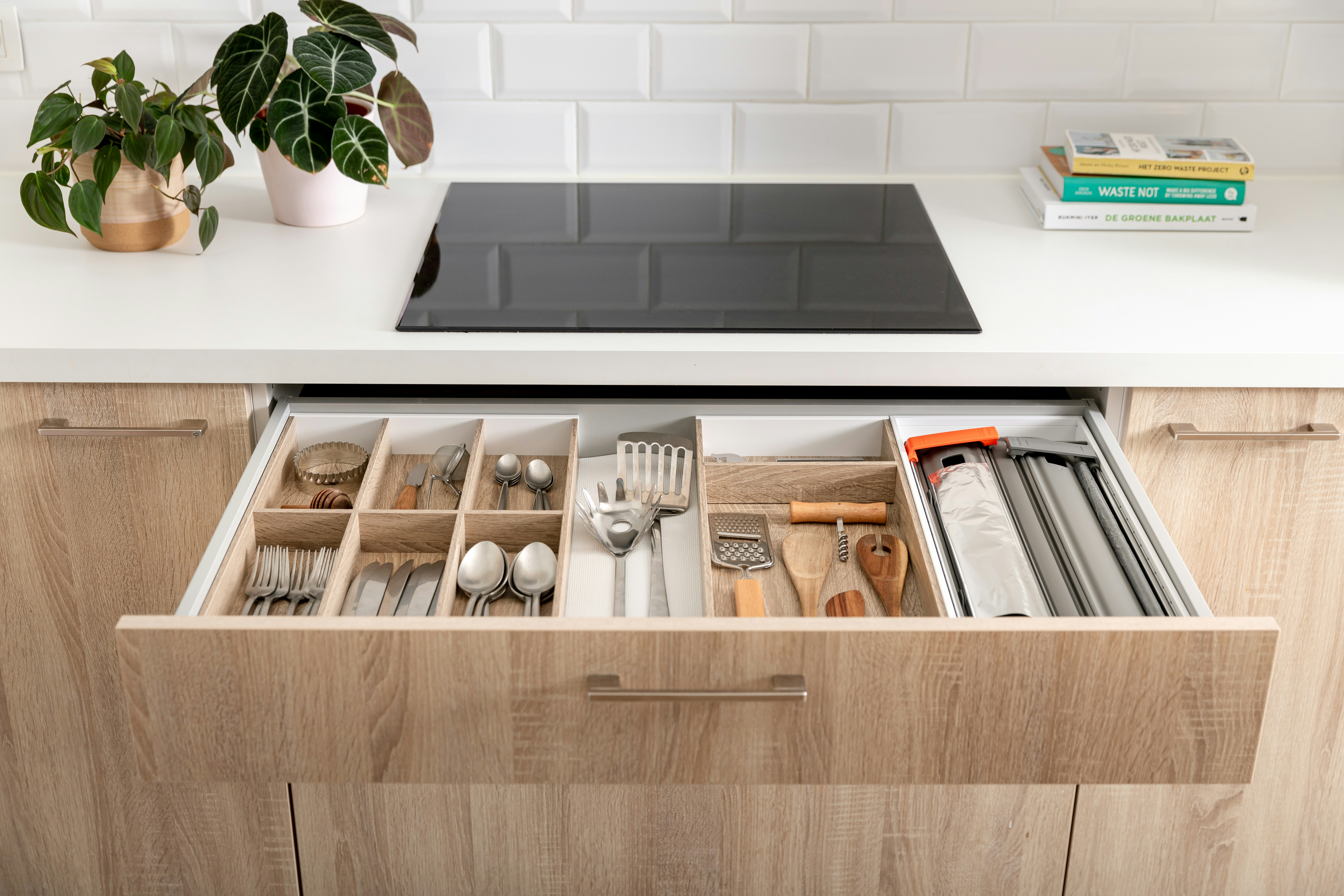
A kitchen can have plenty of cabinets and still feel short on storage. The problem is often not the total number of shelves; it is that the available space is difficult to reach, poorly divided, or being used for items that do not belong there.
Before buying an organizer, identify the specific storage problem. Is a drawer too wide for small utensils? Is the back of a cabinet difficult to reach? Are pantry packages wasting vertical space? Is the countertop becoming a permanent storage area because frequently used items have no convenient home?
That distinction matters. A good organizer should make an existing space easier to use, not simply give you another container to fill. This guide covers nine practical storage solutions and explains where each works, what to measure first, what it can realistically hold, and when it is better to choose another approach.
1. Drawer Dividers for Utensils
A large kitchen drawer can become inefficient when spatulas, whisks, peelers, measuring spoons, and other small tools are mixed together. Adjustable drawer dividers create separate zones so frequently used utensils are easier to find.
Measure before buying
Measure the drawer’s inside width, inside depth, and usable height, not the outside dimensions of the cabinet. Check for hinges, drawer slides, or other hardware that reduces usable space. For an adjustable divider, also check the minimum and maximum expansion range. A divider that technically fits the drawer but cannot be positioned around existing hardware is not a useful fit.
What belongs in it?
Use drawer dividers for items that are:
- used frequently
- relatively flat or short enough to fit comfortably
- easier to retrieve when separated
Do not force tall bottles, large appliances, or bulky cookware into a utensil drawer simply because there is empty space.
Practical tip: Group utensils according to how you actually use them. A “baking” section or “everyday cooking” section may be more useful than arranging everything by object type.
2. Stackable Containers for Pantry Staples
Pantry shelves often lose usable space because flour, rice, cereal, pasta, snacks, and other foods arrive in packages of different shapes and sizes. Uniform containers can make the shelf easier to see and use, but the benefit comes from choosing the right dimensions rather than buying the largest set available.
Before purchasing, measure:
- shelf width
- shelf depth
- clear height between shelves
- the height of the cabinet opening
Then check the container’s outside dimensions, including its lid. A container that fits on the shelf but cannot pass through the cabinet opening is effectively too large. For frequently used dry goods, clear containers can make remaining quantities easier to see. Airtight storage may also be useful for products that benefit from protection from moisture, but follow the food’s storage requirements and the container manufacturer’s instructions.
Do not transfer every pantry item automatically. Keep products in their original packaging when the original package provides important instructions, dates, or other information you need to retain.
3. Under-Shelf Baskets
Under-shelf baskets add a second storage layer below an existing cabinet shelf. They can be useful when there is vertical space above plates, small kitchen linens, wraps, or other lightweight items. They are especially useful when you have unused vertical clearance but do not want to drill into the cabinet.
Before installing one, measure the thickness of the shelf and the clearance below it. Also check how much weight the basket is designed to support. These baskets are best for lightweight items. Heavy glassware or cookware can make an unsupported shelf attachment unstable or difficult to remove.
A useful rule is to store the items you reach for most often in the easiest-to-access layer. Do not create a second shelf that simply hides the first layer.
4. A Lazy Susan for Difficult Corners
Deep corner cabinets and awkward lower cabinets can waste space because the back portion is difficult to reach. A rotating organizer can improve access by bringing stored items forward. It works particularly well for groups of similar objects such as sauces, oils, spices, jars, or cleaning supplies, depending on the cabinet location.
Check these dimensions first
Measure:
- the cabinet’s clear width
- the depth to the obstruction at the back
- the height between shelves
- the door opening
Then check the organizer’s diameter. A rotating tray needs clearance to turn. A large circular organizer that touches the cabinet walls may be less useful than a smaller one. For a two-tier model, make sure the upper tier does not block the items below it.
Do not confuse capacity with accessibility. If you can fit 20 jars but can only comfortably see the front six, the organizer has not solved the real problem.
5. Magnetic Knife Storage
A wall-mounted magnetic knife strip can move knives and other compatible metal tools off the countertop and free a drawer or counter area. The important issue is not simply whether the strip is magnetic. Check the manufacturer’s stated load capacity and installation requirements, and make sure it is securely attached to a suitable wall surface.
Place it where handles can be reached comfortably without creating a hazard near children’s normal activity areas or busy walkways. Keep sharp edges and blades oriented safely according to the product’s instructions. If you prefer not to display knives, an in-drawer knife organizer may be a better solution. Storage should match both your kitchen layout and your comfort level with visible blades.
6. Over-the-Cabinet-Door Racks
Cabinet doors provide another potential storage surface, particularly for slim items. Depending on the design, an over-the-door rack can hold things such as wraps, cutting boards, small cleaning supplies, or kitchen linens. Under-sink doors can be especially useful for lightweight cleaning accessories.
But door-mounted storage has a limitation: the door still has to close. Measure the cabinet opening and the available clearance behind the door. Check whether the rack interferes with shelves, plumbing, drawer fronts, or neighboring doors. For under-sink storage, measure around pipes and the sink bowl before choosing the rack. A narrow rack that fits around the plumbing may be more useful than a larger one that wastes the remaining space.
7. Pull-Out Pantry Shelves
Deep pantry cabinets often have excellent capacity but poor accessibility. Items at the back can become forgotten simply because reaching them requires moving everything in front. Pull-out shelves solve this by allowing the contents to slide toward you.
This is a more involved storage project, so measure carefully before buying hardware. Check the cabinet’s internal width and depth, the available vertical clearance, the shelf’s expected load, and whether the cabinet construction can support the installation. For a DIY installation, follow the slide manufacturer’s instructions rather than assuming all drawer-slide systems install the same way.
Pull-outs are particularly valuable for heavier or frequently used pantry items because you can see more of the shelf without reaching deep into the cabinet. If the cabinet is rented or cannot be modified, use removable bins or smaller organizers instead of permanently altering it.
8. Wall-Mounted Pot Rack
Large pots and pans can consume a surprising amount of cabinet volume because their shapes do not stack as efficiently as plates or containers. A wall-mounted rack can free cabinet space by moving selected cookware to the wall. Before choosing one, consider:
- the wall construction
- the rack’s stated load capacity
- the combined weight of the cookware
- the distance from the cooking surface
- clearance around doors and walkways
- whether the location exposes the cookware to excessive grease or splashing
The rack should be installed using appropriate hardware for the wall type and expected load. Do not rely on a decorative mounting method for heavy cookware. This solution works best when you regularly use the displayed pots and pans. Storing rarely used cookware on an exposed rack may create visual clutter without improving daily workflow.
9. Tiered Cabinet Shelf Organizers
A cabinet shelf can technically hold several rows of dishes while still being difficult to use. A tiered organizer raises the rear or upper row so smaller plates, cups, bowls, or cans are easier to see. Measure the cabinet’s usable height before buying. The organizer must leave enough clearance for the items you intend to store and enough room to remove them without hitting the shelf above.
Tiered organizers are particularly useful when the cabinet is tall but the stored objects are short. For heavy dishes, check the organizer’s load rating and stability. Avoid stacking more weight than the product is designed to support.
Choose the Storage Solution by Problem
Instead of buying all nine products, match the organizer to the problem:
| Storage problem | Useful starting solution | What to check first |
|---|---|---|
| Mixed utensils in one drawer | Drawer dividers | Inside drawer dimensions |
| Irregular pantry packages | Stackable containers | Shelf and container height |
| Empty space under a shelf | Under-shelf basket | Shelf thickness and clearance |
| Hard-to-reach cabinet contents | Lazy Susan | Diameter and turning clearance |
| Knives taking counter space | Magnetic strip or drawer insert | Installation and safe access |
| Unused cabinet-door space | Door rack | Door closure and plumbing/shelf clearance |
| Deep pantry contents hidden at back | Pull-out shelves | Cabinet width, depth, load and construction |
| Bulky cookware filling cabinets | Pot rack | Wall strength, load and clearance |
| Short items disappearing in tall cabinets | Tiered organizer | Vertical clearance and load |
This table is intentionally simple: solve the actual bottleneck first.
A 10-Minute Kitchen Storage Audit
Before ordering anything, open every drawer and cabinet and identify the three spaces that cause the most frustration. For each one, write down:
What is the problem? For example, “small utensils get mixed together.”
What is stored there? List the actual items rather than estimating.
How often are they used? Everyday items should generally be easier to reach than occasional items.
What space is available? Measure width, depth, height, and obstructions.
What would make retrieval easier? The answer might be an organizer, but it might also be moving the items to a different cabinet.
That final question prevents unnecessary purchases. Sometimes the best storage improvement costs nothing.
A Worked Example: Fixing One Problem Cabinet
Imagine a lower cabinet that is 24 inches wide and 22 inches deep. It contains pots, lids, a colander, and several pans. The main problem is not capacity; it is that the most frequently used pan is always behind two other items.
Instead of immediately buying multiple organizers, start by removing everything and grouping the cookware by frequency of use. Place the everyday pan and pot in the easiest position. Store occasional cookware farther back. If the cabinet remains difficult to access because of its depth, then consider a properly sized pull-out shelf or another solution designed for the cabinet.
The sequence matters: edit first, organize second, buy last.
Common Kitchen Storage Mistakes
Buying organizers before measuring
A product photograph cannot tell you whether the organizer fits around your cabinet hinges, plumbing, drawer slides, or shelf spacing.
Organizing items you rarely use
Storage becomes more useful when the easiest locations are reserved for the things you reach for regularly.
Maximizing capacity instead of accessibility
A completely full cabinet may technically store more but take longer to use. Leave enough space to retrieve everyday items comfortably.
Ignoring installation limits
Wall-mounted racks, pull-outs, and other fixed systems have load and mounting requirements. Follow the manufacturer’s instructions and match the hardware to the installation surface.
Creating duplicate storage
If one drawer already contains several unused organizers, adding another tray will not solve the underlying problem. Remove what is unnecessary first.
Treating every problem as a product problem
Sometimes moving cookware, grouping pantry staples differently, or removing rarely used items creates more usable space than buying another organizer.
What to Buy First on a Limited Budget
If your budget is small, start with the storage problem that affects you every day.
Low-cost improvement: drawer dividers, shelf risers, or a carefully selected basket.
Medium-cost improvement: containers, a lazy Susan, or a cabinet-door organizer where measurements support it.
Larger improvement: pull-out pantry shelves or a professionally installed storage system when the cabinet layout justifies the expense.
Do not buy nine solutions simply because the article contains nine ideas. One organizer that solves a daily frustration is more valuable than a collection of products that creates new clutter.
Kitchen Storage Checklist
Before buying any storage accessory, ask:
- What exact problem am I solving?
- Have I measured the usable space rather than the outside of the cabinet?
- Does the product leave enough clearance to open, rotate, slide, or close normally?
- What is its load capacity?
- Is installation required, and is the mounting surface suitable?
- Will frequently used items remain easy to reach?
- Could rearranging or removing items solve the problem without spending money?
- If I move, rent, or change the cabinet later, can the organizer be reused?
Final Thoughts
Good kitchen storage is not about fitting the maximum number of objects into every cabinet. It is about making the things you use easier to find, reach, return, and maintain. Start with the three spaces that frustrate you most. Measure them carefully, remove items that do not belong, and decide whether the problem is capacity, access, visibility, or workflow. Then choose the simplest solution that addresses that specific issue.
Drawer dividers can improve a utensil drawer. A tiered shelf can make a tall cabinet easier to see. A pull-out can rescue a deep pantry. A door rack can use otherwise wasted space. But none of them should be purchased automatically.
The best kitchen organizer is the one that removes a real obstacle from your daily routine without creating another thing to manage.
Disclaimer: Glimerz is a participant in the Amazon Services LLC Associates Program, an affiliate advertising program designed to provide a means for sites to earn advertising fees by advertising and linking to Amazon.com. When you click certain product links in this post and make a qualifying purchase, we may earn a small commission at no additional cost to you. We only recommend products we believe add genuine value to our readers.
