
A small rental kitchen has two problems at once: space is limited, and the walls and cabinets may not be yours to modify. That makes organization less about adding permanent storage and more about making better use of the surfaces and clearances you already have. The most useful renter-friendly organizers are not necessarily the ones that hold the most. They are the ones that fit your kitchen, make frequently used items easier to reach, and can be removed without creating a repair project when you move.
Before buying anything, check your lease and any building rules. “No drilling” does not automatically mean every adhesive, over-door, or magnetic product is approved. A landlord may have specific restrictions on adhesives, and some surfaces can be damaged even when a product is marketed as removable.
Start With a Storage Audit, Not a Shopping Cart
Take 15 minutes to identify the three areas that cause the most frustration. You may find that one cabinet is badly arranged while another contains items you rarely use. For each problem area, note:
- what you are storing there
- which items are used daily or weekly
- what is difficult to reach
- how much vertical space is unused
- whether the surface is suitable for a removable organizer
- whether the problem is capacity, access, visibility, or simply too much stuff
Then measure the space. For cabinets and drawers, record usable width, depth, and height. For a cabinet door, measure the door thickness and the clearance available behind it. For a gap beside an appliance, measure the narrowest point rather than the widest point.
This simple audit prevents one of the most common organization mistakes: buying an organizer first and discovering that it does not fit.
1. Use the Inside of Cabinet Doors
The inside of a cabinet door can provide useful storage for lightweight, slim items without consuming a shelf. Depending on the product, door-mounted organizers can hold cutting boards, food wraps, small kitchen linens, pot lids, or cleaning supplies. Under the sink, they can also be useful for lightweight accessories, provided they do not interfere with plumbing or the cabinet door.
Measure three things
Before buying a door organizer, check:
- Door thickness: the mounting hook or bracket must fit securely.
- Back-of-door clearance: the organizer should not collide with shelves or cabinet contents when the door closes.
- Door opening: make sure the added weight does not prevent the door from opening normally.
Do not assume that a product described as “over the door” fits every cabinet. Manufacturers use different dimensions and mounting designs.
2. Tension Rods for Vertical Storage
Spring tension rods can create simple dividers inside cabinets without drilling. They are useful for keeping baking sheets, cutting boards, trays, or cooling racks upright instead of stacked. They can also create a hanging area for lightweight cleaning bottles under a sink, but the rod must be firmly seated and the cabinet must have suitable side walls.
The key advantage is adjustability. You can reposition a tension rod when your storage needs change.
Use tension rods carefully
A tension rod is not a structural shelf. Check the manufacturer’s load guidance and use it only for the type of storage it is designed to support. Heavy cookware or large glass bottles can exceed the practical capacity of a small rod.
For a 12-inch-wide cabinet, for example, you might install two or three vertical dividers to separate baking sheets and boards. The exact number should be based on the thickness of the items rather than an arbitrary count.
3. Turn a Metal Refrigerator Side Into Storage
A magnetic rack can be useful on a refrigerator’s steel side when that surface is accessible and the magnet is rated for the intended load. Spices, small containers, kitchen notes, and other lightweight items can be moved off a crowded counter. The benefit is particularly noticeable in a small kitchen because the storage does not occupy a drawer or require a wall installation.
However, not every refrigerator side is magnetic, and not every magnetic product has the same holding strength. Test the surface and follow the organizer’s load instructions before placing glass jars or other heavy objects on it. If the refrigerator is frequently moved for cleaning or service, leave enough clearance for the organizer to be removed without difficulty.
4. Add a Second Level Inside Tall Cabinets
Many cabinets have more vertical space than the stored dishes or cans actually need. A shelf riser uses some of that empty height to create a second storage level. Measure the clear height from the existing shelf to the cabinet above it. Then compare that measurement with the riser height plus the items you plan to place underneath and on top.
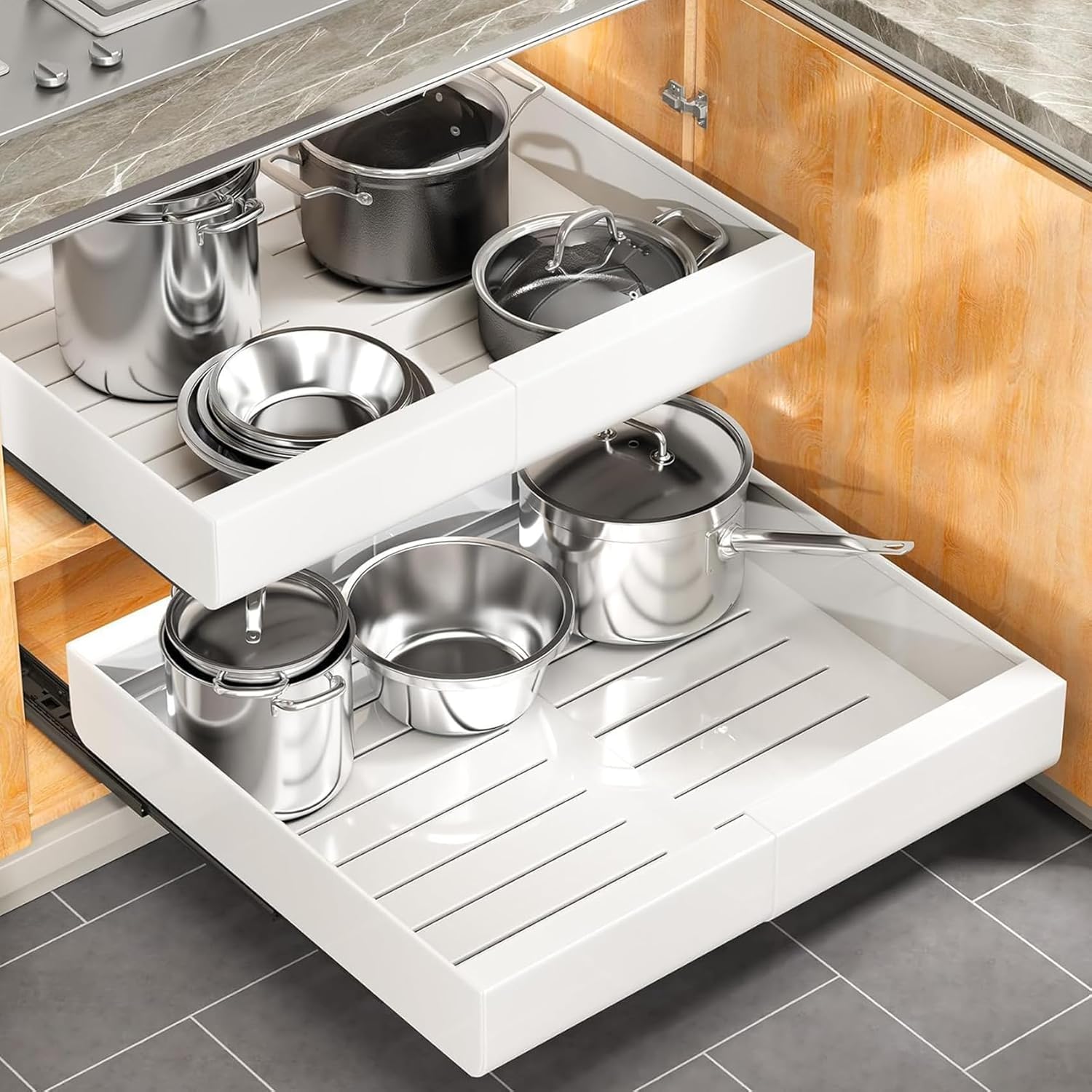
A riser works best when both levels remain easy to access. If the upper shelf forces you to lift everything below it to reach the back, you have increased capacity but not necessarily improved organization. For a small cabinet holding mugs and bowls, for example, a riser may create a useful upper zone for mugs while bowls remain below. For heavy cookware, check the product’s stability and load rating before stacking weight on it.
5. Adhesive Hooks — With a Surface Test First
Adhesive hooks can be useful for oven mitts, lightweight measuring tools, towels, or other small items. They are attractive to renters because they can avoid permanent holes. But “removable” does not mean “risk-free on every surface.” Paint, wallpaper, tile, laminate, and finished wood can react differently to adhesives.
Before using an adhesive hook:
- read the manufacturer’s surface restrictions
- clean and prepare the surface as instructed
- test one hook in an inconspicuous location when possible
- observe the stated weight limit
- allow any required curing time before loading it
Do not hang heavy cookware from a small adhesive hook simply because the hook feels firmly attached. Match the load to the product’s published rating.
6. Fill Narrow Gaps With a Rolling Cart
A slim rolling cart can turn an unused gap beside a cabinet or refrigerator into movable storage. It is especially useful when you cannot install a permanent pull-out pantry. Before choosing one, measure the narrowest width of the gap, its depth, and the available height. Also check whether the cart’s wheels need additional clearance to turn.
Use the cart for categories that benefit from being moved as a group: pantry supplies, baking ingredients, beverages, coffee equipment, or cleaning items depending on its location. Avoid placing a cart immediately beside a hot cooking surface unless its materials and intended use make that appropriate. A movable organizer should improve the kitchen workflow, not create a new obstruction.
7. Organize the Countertop by Frequency of Use
A small kitchen can feel crowded even when the cabinets are well organized because too many daily-use items remain on the counter. Instead of trying to remove everything, divide countertop items into three groups:
Daily: appliances or tools used almost every day can stay accessible if there is room.
Weekly: keep these within easy reach but preferably in a cabinet, drawer, or cart.
Occasional: store these away from the main preparation area.
This approach is more realistic than a rule that says the counter must always be empty. A coffee maker that is used every morning has a different storage requirement from a waffle maker used twice a year. For small counters, also protect a clear preparation zone. Being able to put down a cutting board or mixing bowl is often more valuable than displaying another accessory.
8. Use Vertical Dividers for Trays and Boards
If baking sheets, cutting boards, cooling racks, and serving trays are stacked horizontally, the largest item often becomes the least convenient one to retrieve. A removable divider system can keep these items upright. Tension rods are one option; freestanding dividers are another.
Group objects by size and frequency. Everyday cutting boards can occupy the easiest position, while large serving trays used only for holidays can go farther back. Measure the cabinet before adding dividers, and leave enough width for each item to be removed without scraping adjacent surfaces.
9. Create a Removable Prep Zone
Renters sometimes focus so heavily on storage that they overlook the kitchen’s workflow. If the only clear counter area is far from the refrigerator, sink, or utensils, cooking can still feel inefficient.
A small rolling cart can act as a temporary prep or serving station when its surface is stable and suitable for the intended use. A shelf riser can keep frequently used seasonings visible. A compact cutting-board holder can keep boards upright in a cabinet.

The goal is not to add more equipment. It is to reduce unnecessary movement between the three areas you use most: storage, washing, and preparation.
Match the Organizer to the Problem
| Your problem | Start with | Check before buying |
|---|---|---|
| Mixed small utensils | Drawer divider or small tray | Drawer dimensions |
| Baking sheets stacked flat | Tension rod or divider | Cabinet width and item thickness |
| Unused cabinet height | Shelf riser | Vertical clearance |
| Small items with no home | Adhesive hook | Surface and load rating |
| Spices crowding a counter | Magnetic rack | Magnetic surface and load |
| Narrow unused gap | Rolling cart | Narrowest width and wheel clearance |
| Crowded countertop | Frequency-based editing | Daily-use requirements |
| Hard-to-reach cabinet contents | Repositioning or removable bins | Depth and access |
The table is a starting point, not a shopping list. The cheapest solution may be moving an item rather than buying an organizer.
Three Renter-Friendly Setups
Setup A: The tiny galley kitchen
If counter space is the main problem, prioritize a magnetic rack for suitable lightweight items, a shelf riser inside one cabinet, and a slim cart if there is a genuinely usable gap. Keep the main counter preparation area clear. Avoid adding organizers that consume the very counter space you are trying to recover.
Setup B: The cabinet-heavy kitchen
If the kitchen has plenty of cabinets but poor access, start with shelf risers, vertical dividers, and carefully selected door storage. Reassign prime locations to everyday cookware and move occasional items higher or farther back.
Setup C: The shared rental kitchen
When several people use the kitchen, organization should be understandable to everyone. Group supplies by task — breakfast, baking, everyday cooking, drinks — rather than creating a system only one person knows. Labeling removable bins can help, especially when multiple people share pantry shelves.
What About Adhesive and Magnetic Storage Near Heat or Water?
This is where renter-friendly does not automatically mean suitable. Keep adhesives away from surfaces where the manufacturer says they should not be used. Under a sink, consider moisture exposure and inspect removable organizers periodically. Near a stove, consider heat, grease, and the material of the organizer. Near the dishwasher or sink, make sure the product is appropriate for the environment.
If a storage solution becomes loose, warped, damaged, or difficult to clean, remove it rather than trying to make it carry more weight than intended.
A Simple $50 Organization Plan
You do not need to reorganize the entire kitchen at once.
Suppose you have a limited budget. Start by measuring your worst drawer and one difficult cabinet. If a drawer divider solves a daily problem, make that the first purchase. If the cabinet has unused vertical space, add one appropriately sized riser. Only then consider a magnetic rack or rolling cart if the remaining problem is still significant.
The exact prices will vary, but the principle is stable: spend first on the problem that affects your routine most often. This also makes it easier to stop. If one inexpensive change solves the problem, you do not need to buy five more organizers simply because they are available.
Before You Install Anything
Use this renter safety check:
- Read your lease before applying adhesives or adding fixtures.
- Photograph the area before installing anything.
- Measure the organizer and the installation space.
- Check the manufacturer’s surface and load requirements.
- Test removable products in an inconspicuous location when practical.
- Keep heavy items in storage systems designed for their weight.
- Make sure doors, drawers, appliances, and walkways still operate normally.
- Recheck adhesive or tension-mounted products periodically.
- Remove products according to the manufacturer’s instructions when you move.
- Photograph the area again after removal if your deposit is a concern.
Final Thoughts
A renter-friendly kitchen does not need permanent built-ins to become easier to use. The better strategy is to work with the kitchen you have: measure first, identify the actual bottleneck, use vertical and overlooked surfaces carefully, and choose removable storage only when the product and surface are compatible.
Tension rods can divide trays. Shelf risers can use otherwise empty cabinet height. Magnetic racks can make a suitable refrigerator side useful. Adhesive hooks can handle lightweight items when the surface allows them. A rolling cart can turn a genuine narrow gap into movable storage.
But the most important organizing tool is still the audit you do before shopping. If an item is rarely used, moving or removing it may create more space than any accessory. If a daily-use item is buried at the back of a cabinet, changing its location may solve the problem completely.
The best renter kitchen organization system is not the one that adds the most storage. It is the one that makes your limited space easier to use while remaining safe, reversible, and respectful of the property you are renting.
Disclaimer: Glimerz is a participant in the Amazon Services LLC Associates Program, an affiliate advertising program designed to provide a means for sites to earn advertising fees by advertising and linking to Amazon.com. When you click certain product links in this post and make a qualifying purchase, we may earn a small commission at no additional cost to you. We only recommend products we believe add genuine value to our readers.

