Why Most People Own the Wrong Knives
Walk into any kitchen store and you’ll find 14-piece knife sets, single blades priced like small appliances, and enough jargon—high carbon, full tang, Rockwell hardness, hollow edge—to make you put the whole thing back and reach for your old block at home. The result is that most home cooks end up with either too many mediocre knives or a single expensive one that doesn’t cover every job they need done. Neither situation is ideal, and both are easy to fix once you understand what a knife is actually being asked to do.The goal isn’t to own every blade on the market. It’s to own the right two or three, understand how to maintain them, and never again reach for the wrong knife because you don’t have the right one.
The Only Three Knives Most Home Cooks Need
Professional knife kits tend to be specialized because restaurant cooks repeat the same tasks hundreds of times a shift. At home, you’re doing a wider variety of prep work in smaller volumes, which means a small, well-chosen set covers nearly everything.
The Chef’s Knife (8 to 10 Inches)
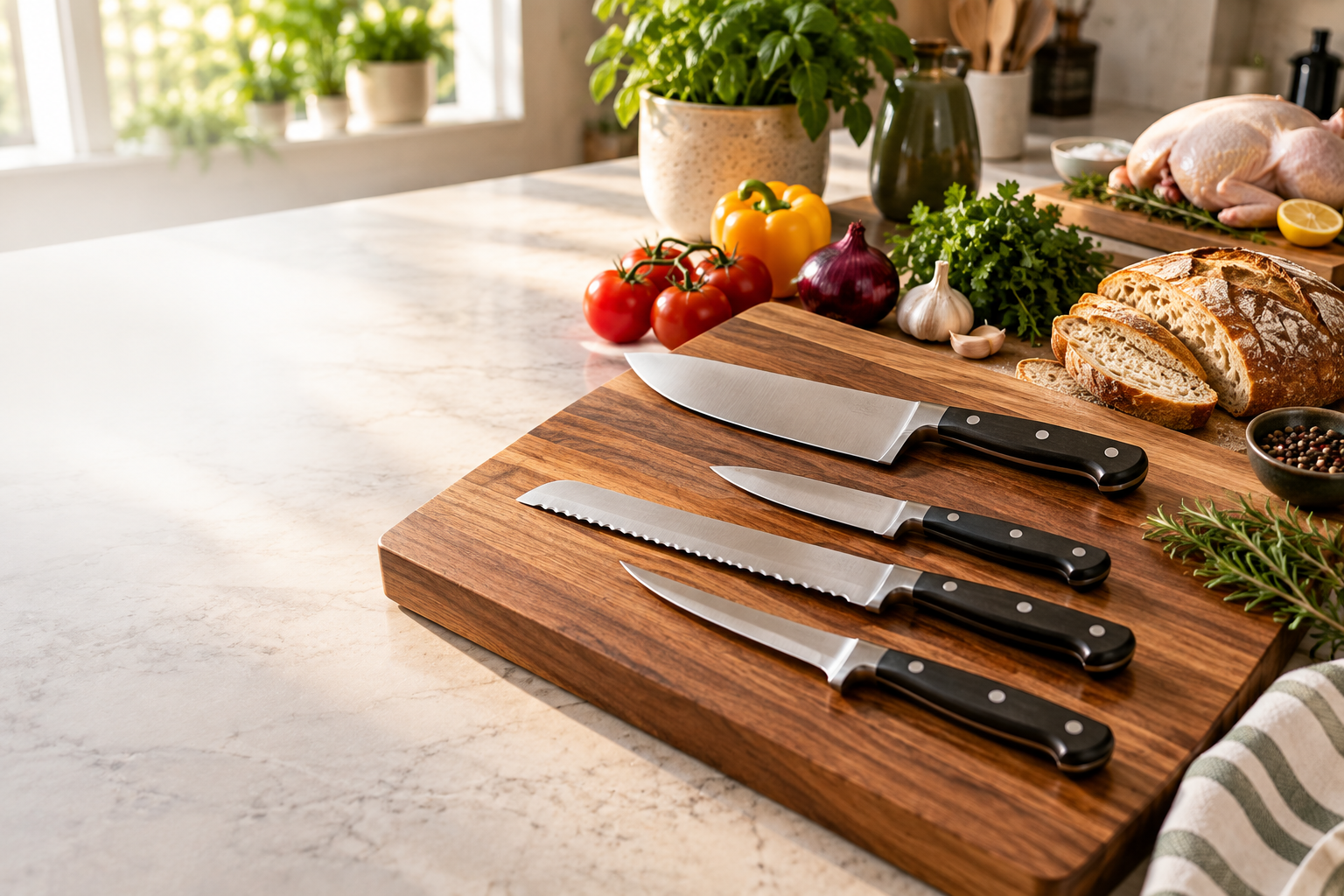
This is the workhorse. An 8-inch chef’s knife handles roughly 80% of kitchen prep—chopping vegetables, slicing meat, mincing herbs, breaking down a whole chicken if you hold it at the right angle. If you’re going to spend money on one blade, this is where it goes. The difference between a $30 chef’s knife and a $120 one is real: better steel holds an edge longer, the balance feels more deliberate, and the handle doesn’t fatigue your hand on longer prep sessions. German-style knives (like those made by Wüsthof or Zwilling) are slightly heavier with a curved belly that makes rocking cuts natural. Japanese-style knives (like a Shun or a MAC) tend to be lighter, thinner, and harder steel, which means a sharper initial edge but one that requires more careful maintenance—they chip more easily on hard foods like frozen meat or butternut squash. Neither is objectively better; it comes down to how you cut. If you use a rocking motion, go German. If you prefer a straight push-cut or pull-cut style, a Japanese blade often feels more responsive.

The Paring Knife (3 to 4 Inches)
A paring knife is for the detail work a chef’s knife is too unwieldy to handle: peeling fruit, deveining shrimp, trimming fat from a chicken thigh, cutting the cores out of strawberries. It’s the knife you hold in one hand while the food is in the other, which means weight and control matter more than length. A 3.5-inch blade is the most versatile size—long enough to segment a grapefruit, short enough to maneuver around a pepper. You don’t need to spend much here; a $20 to $40 forged paring knife will outperform most expensive options because the tasks don’t demand extraordinary hardness.
The Serrated Bread Knife (9 to 10 Inches)
A bread knife’s serrated edge does what a straight blade can’t: it saws through a crispy crust without compressing the soft interior beneath it. But it earns its place in more than bread. A good serrated knife slices tomatoes cleanly when they’re so ripe that a straight edge would crush them, handles delicate pastry without dragging, and cuts through watermelon rinds and pineapple skin without slipping. You rarely need to sharpen a serrated blade (most home cooks never do), which makes it genuinely low maintenance. One thing to avoid: going too short. A 9-inch minimum gives you the stroke length to cut through a full boule in a single smooth pull.
What the Specs Actually Mean
Two numbers matter more than brand names when you’re comparing knives on a shelf. The first is the Rockwell hardness rating, usually expressed as HRC. Harder steel (58–65 HRC, typical of Japanese knives) holds a sharper edge for longer but is more brittle. Softer steel (54–58 HRC, common in German knives) dulls faster but is much more forgiving if you accidentally hit a bone or a cutting board edge too hard. For everyday cooking on a wooden or plastic board, either works fine. If you use a glass or ceramic board, harder steel chips noticeably faster. The second is the construction method: forged versus stamped. Forged knives are shaped from a single piece of heated steel, which typically produces better balance and durability. Stamped knives are punched out of a steel sheet, which can still produce a sharp, serviceable blade—especially in the mid-price range—but often feels lighter and less balanced. The simplest check: a forged knife usually has a bolster (the thick collar between the blade and handle), while a stamped one typically doesn’t.

Maintaining Your Knives So They Stay Sharp
Buying good knives and then ignoring maintenance is like buying good shoes and wearing them in the rain every day. Two habits make the biggest difference.First, hone regularly. A honing steel doesn’t sharpen a blade—it realigns the microscopic edge that folds over with use. Running your knife along a honing rod before or after each use keeps the edge performing at its best between proper sharpenings. The technique matters: hold the steel vertically, tip down on a cutting board, and draw the blade from heel to tip at about a 15-degree angle for Japanese knives, 20 degrees for German. Second, sharpen once or twice a year depending on how often you cook. A whetstone gives the most control and is worth learning if you own quality knives. A pull-through sharpener is faster but removes more material each pass. Either beats a completely dull blade.Storage also affects edge life more than most people realize. Tossing knives loose in a drawer dulls them against other utensils. A magnetic strip mounted at the side of a cabinet, a countertop knife block, or individual blade guards all protect the edge without taking up much space.
Matching Your Knives to Your Cooking Style
If most of your cooking involves vegetables, grains, and fish, a lighter Japanese-style chef’s knife pairs beautifully with a small paring knife and your serrated knife for bread and fruit. If you regularly break down whole chickens, handle dense root vegetables, or work quickly and forcefully through prep, a heavier German chef’s knife gives you more confidence and forgiveness.One knife frequently worth adding as a fourth option: a boning knife (6 inches, flexible). If you buy meat in larger cuts or whole birds even occasionally, a flexible boning knife removes meat from bone with far more precision and less waste than trying to work around with a chef’s knife. It won’t replace any of your core three, but it pulls real weight for that specific task.
The Practical Takeaway
Start with a chef’s knife you can hold before buying—balance matters as much as brand—add a paring knife and a long serrated knife, and keep them properly stored and honed. That setup handles nearly every task in a real home kitchen without the clutter of a drawer full of blades you reach past every time you’re looking for the right one.

