Why Most People Have the Wrong Mixing Bowls
Mixing bowls are easy to take for granted. You inherit a set, grab something cheap at a homeware sale, or just use whatever is in the back of the cupboard. But if you’ve ever tried to fold whipped cream in a bowl that’s too shallow, or wrestled with a lightweight plastic bowl spinning across the counter while you whisk, you already know that bowl choice matters more than it looks. The right mixing bowl for your kitchen depends almost entirely on how you cook — not on what looks good in a photo.
A good bowl also works best when it fits naturally into the rest of your kitchen routine. The utensils you use with it, how easily the bowl stays in place, and whether it is comfortable to pour from can all make everyday preparation easier.
The Case for Owning More Than One Material
Most kitchens benefit from having at least two different bowl materials, because no single type does everything well.
Stainless Steel
Stainless steel is the workhorse. It’s lightweight, nearly indestructible, non-reactive with acids like lemon juice or vinegar, and goes from fridge to counter without complaint. The main drawback is that it has no grip on a counter surface, which is why a damp kitchen towel underneath is a necessary habit. Stainless steel also doesn’t work in a microwave, and it transfers temperature quickly — useful when you need to set a bowl over ice to chill a sauce, but frustrating if you’re proofing bread and want to retain warmth. For everyday mixing tasks, salad tossing, and anything involving citrus or tomato, stainless is the easiest choice to live with.
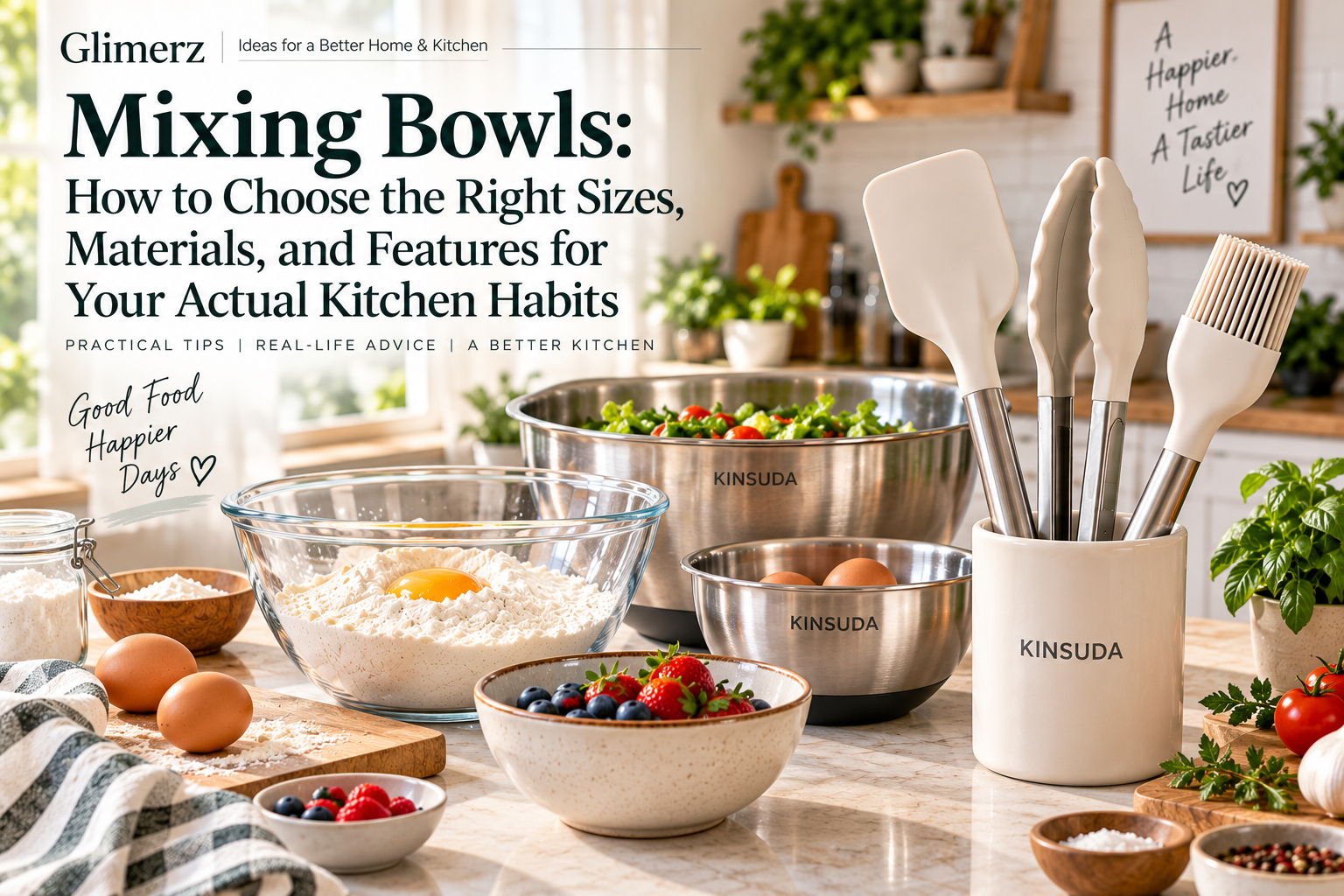
When you’re working with a stainless bowl, having a few long-handled silicone utensils can also make preparation more comfortable. A spatula is useful for scraping batter from the sides, while tongs and a basting brush cover other everyday cooking jobs.
A Simple Utensil Companion
One example is the KINSUDA Silicone Spatula, Tongs and Basting Brush Set, which comes as a three-piece set with an 11.4-inch length. The set includes a silicone spatula, tongs, and basting brush, making it a practical companion to a bowl collection rather than another bowl competing for cupboard space.
The gray version is particularly easy to pair with stainless-steel or neutral-colored kitchen equipment. Its silicone construction is designed for cooking, baking, and serving, while the product listing also describes it as heat resistant, dishwasher safe, and non-scratch.
Glass
Glass bowls are heavier, which actually helps them stay put while you stir. They’re microwave-safe, oven-safe up to certain temperatures (check the manufacturer’s specs), and genuinely non-reactive, which makes them the best choice for marinating meat or mixing anything acidic. The visibility is useful too — you can check the bottom of a batter without tipping the bowl. The trade-off is fragility. Glass bowls chip and crack if you’re not careful with them, and they’re bulkier to store. If you do one thing with glass bowls, use them for marinating and microwave reheating tasks and let stainless or another material handle daily mixing.

A glass mixing bowl is therefore one of the most useful additions to a basic collection, particularly if you regularly prepare marinades, sauces, or ingredients that need to go directly into the microwave. Its weight also makes it useful when you don’t want the bowl moving around while you work.
Ceramic
Ceramic bowls are beautiful and heavy, which is both their appeal and their limitation. They’re great for anything you want to serve directly from the bowl — think homemade guacamole, cookie dough you’re sharing at the table, or a dip that needs to look presentable. But they’re not practical as your primary mixing bowl. They’re heavy to handle with one hand, they chip more easily than stainless, and they’re slow to clean thoroughly when batter gets into decorative seams. Think of ceramic as a specialty bowl that earns its place on the shelf for specific uses.
Plastic and Melamine
Plastic bowls are lightweight and cheap, but they absorb odors over time, scratch easily, and can hold onto fats in a way that makes whipping egg whites or cream consistently harder. Melamine is slightly more durable and less prone to staining, but the same limitations apply. If you have young children in the kitchen or need an unbreakable option, plastic makes sense. For serious cooking, it should be a secondary option rather than your main set.
Getting the Sizes Right
Most mixing bowl sets are sold in three sizes, and most people find they use the two extremes far more than the middle one. The key is understanding what each size actually does.
A small bowl (around 1–1.5 quarts) is for prep work: whisking one or two eggs, mixing a quick vinaigrette, holding pre-measured spices before they go into the pan. You’ll use this more than you think. A medium bowl (around 3 quarts) covers the mid-range tasks — tossing a simple salad, mixing pancake batter for two people, coating chicken before cooking. A large bowl (5–6 quarts or bigger) is where the serious work happens: bread dough, double batches of cookie dough, a big pasta salad for a group, or anything where ingredients will double in volume as you mix.
If you’re starting from scratch and need to prioritize, buy a large and a small before a medium. Most cooks reach for those two sizes far more frequently, and a medium bowl often ends up being either slightly too small or slightly too big for the job anyway.
Features Worth Paying Attention To
Non-slip bases — either rubber rings or silicone feet — are worth seeking out on any bowl you plan to use with an electric hand mixer or when whisking for an extended period. Without them, the bowl walks across the counter and you spend half your energy managing it. Some stainless bowls have a spout and a handle molded into the rim, which sounds small but makes a real difference when pouring batter into a cake tin or muffin cups.
The tools you use alongside the bowl matter too. A silicone spatula is especially useful when mixing thick batter because it can scrape the sides and bottom rather than leaving ingredients behind. Tongs can handle ingredients after preparation, while a basting brush is useful when cooking or baking calls for an even coating.

Another KINSUDA Option: White
If you prefer a lighter kitchen aesthetic, the KINSUDA 3-Piece Silicone Spatula, Tongs and Basting Brush Set in White provides the same basic three-tool arrangement in a white finish. It includes the 11.4-inch silicone spatula, tongs, and basting brush and is listed as dishwasher safe and non-scratch.
The white version can work particularly well in a bright, neutral kitchen where you want cooking tools to blend into the overall look rather than stand out.
Remember that the gray and white versions are variations of the same three-piece KINSUDA set, rather than two completely different utensil sets. The choice between them is mainly about the finish you prefer.
Nesting sets save storage space significantly, especially in smaller kitchens. If you’re buying a set, check that the bowls actually nest flat and don’t require awkward stacking. Straight-sided bowls (as opposed to those that slope sharply inward) tend to be more useful for mixing because a spatula or whisk can reach the sides without the angle working against you.
Pouring lips are worth having on at least one bowl, ideally the large one. Lids are worth having on at least one as well — covering a bowl of marinating chicken or letting bread dough prove without cling film is a convenience you’ll notice quickly.
A Practical Starting Point
For most home cooks, a useful starting collection looks like this: a large stainless steel bowl with a non-slip base for everyday mixing, a medium or large glass bowl for marinating and microwave tasks, and a small bowl in any material for prep. That’s three bowls that cover nearly every situation without taking over an entire cupboard. Add a ceramic serving bowl only if you entertain regularly and want something you’re comfortable putting on the table.
The same practical approach applies to utensils. You don’t necessarily need a drawer full of specialized tools. A dependable spatula, a useful pair of tongs, and a basting brush can cover several everyday cooking and baking jobs without adding unnecessary clutter.
Avoid buying large nested sets just because the price per bowl seems reasonable — you’ll end up with sizes you never use and a storage problem you didn’t start with. Buy what your cooking actually demands, and fill in gaps as you notice them.
The best mixing-bowl collection isn’t necessarily the biggest one. It is the collection that gives you the right size, material, and features for the way you actually cook. Add useful supporting tools when they solve a real problem, and your kitchen becomes easier to work in without becoming more crowded.

