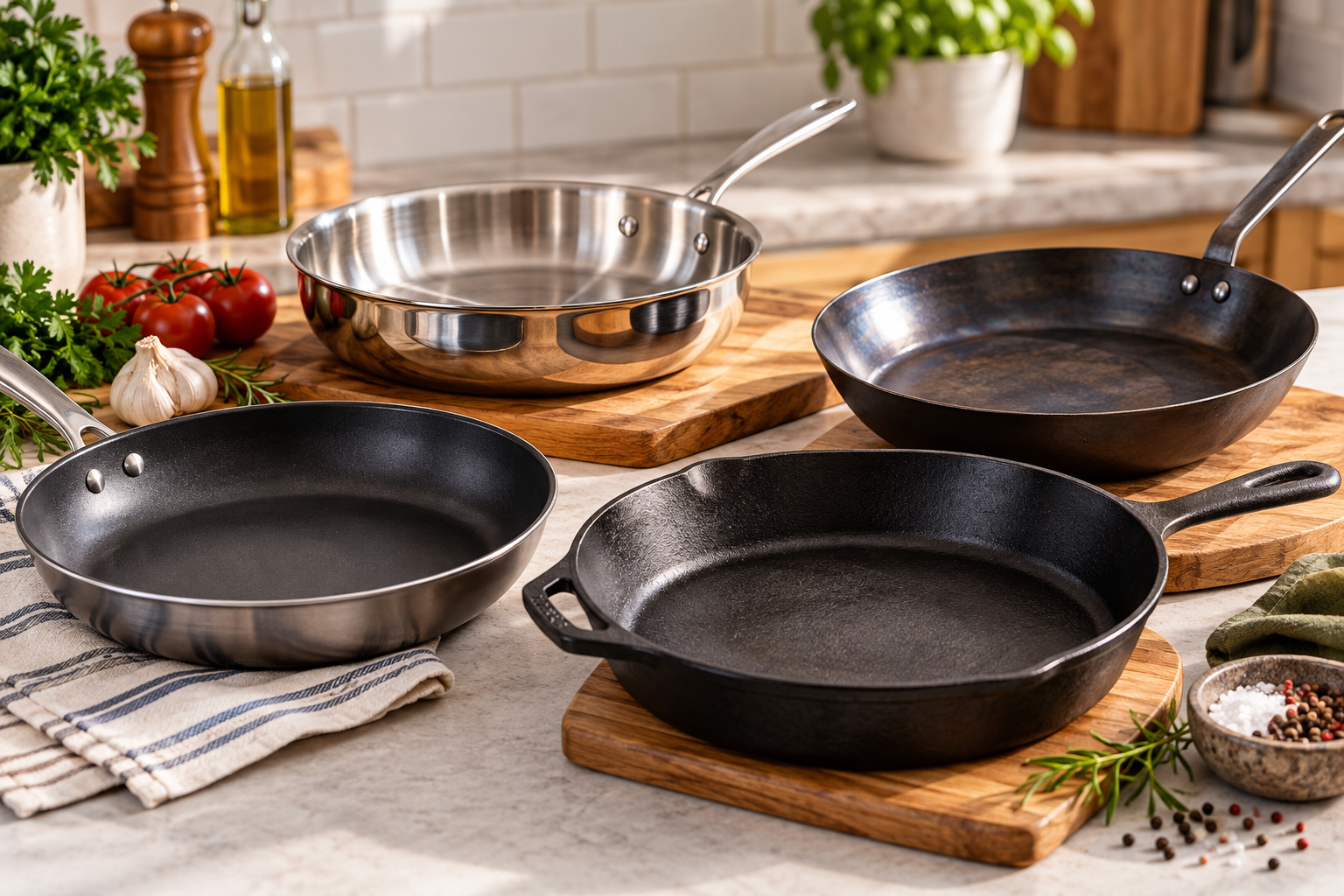
Why Material Matters More Than Brand
Walk into any kitchen shop and the cookware wall can stop you cold. There are gleaming stainless sets, matte ceramic pans, well-worn cast iron skillets, and lightweight nonstick options, all at wildly different price points. Most buyers default to a matching set because it looks tidy, but a uniform set built from one material rarely suits the full range of cooking anyone actually does. Understanding what each material is physically doing to your food — how it conducts heat, whether it reacts with acidic ingredients, how it handles high temperatures — makes the decision much less intimidating and the result far more practical.
Stainless Steel: The Workhorse That Rewards Patience
Stainless steel is the material in most professional kitchens for good reason. It doesn’t react with acidic foods like tomatoes or wine, it can go from stovetop to oven without issue, and it lasts essentially forever if you don’t abuse it. The catch is that pure stainless conducts heat poorly and unevenly on its own, which is why quality stainless pans have an aluminum or copper core sandwiched into the base — or, in fully-clad pans, running up the sides as well. That distinction matters: a disc-bottom pan concentrates heat only at the base, while fully-clad construction like a tri-ply or five-ply pan distributes it more evenly across the cooking surface.
The other thing stainless demands is proper technique. Food sticks to a cold stainless pan almost immediately, which frustrates people who are used to nonstick. The fix is simple: heat the pan thoroughly before adding oil, then let the oil shimmer before adding food. Proteins will release naturally once they’ve formed a crust — trying to move them too early is the cause of most sticking. That stuck-on fond, incidentally, is flavor you deglaze into a sauce, which is one of stainless steel’s genuine advantages over nonstick.
A 10-inch or 12-inch stainless skillet and a 3-quart saucepan cover most everyday cooking tasks. If you’re making soups, braising, or cooking for more than two people regularly, a 5- or 6-quart Dutch oven in stainless or enameled cast iron earns its cabinet space quickly.

Nonstick: Useful Within Limits
Nonstick pans have a narrower range of appropriate tasks than their popularity suggests. They’re genuinely excellent for eggs, delicate fish, crepes, and anything where sticking would ruin the result and where you’re cooking at moderate heat. What they’re not suitable for is high-heat searing — the coating degrades above roughly 500°F (260°C), and most nonstick pans shouldn’t go above medium-high on a domestic burner. They also shouldn’t go in the oven above 400–450°F depending on the manufacturer, and they’re not broiler-safe.
The lifespan issue is real. Even with careful use and wooden or silicone utensils, most nonstick coatings are meaningfully degraded within three to five years. Scratches, metal utensils, and stacking pans without protection all accelerate that. Treat nonstick as a consumable rather than an investment: buy a decent 10-inch pan, use it specifically for tasks where it excels, and replace it when the coating shows wear rather than nursing it along.
Ceramic-coated pans are sometimes marketed as a cleaner alternative to PTFE-based nonstick. They work similarly at lower temperatures but tend to lose their slickness faster — often within one to two years of regular use. They’re worth considering if you prefer to avoid traditional coatings, but the trade-off is a shorter functional life.
Cast Iron: Heat Retention Over Heat Control
Cast iron heats slowly and unevenly at first, which makes it a poor choice for anything requiring quick, precise temperature changes. What it does exceptionally well is hold heat once it’s fully preheated — typically 8 to 10 minutes over medium heat. That retention makes it the right pan for searing steaks, baking cornbread, frying chicken, and cooking anything that benefits from sustained, even heat from below. A 10-inch or 12-inch cast iron skillet can go from stovetop to a 500°F oven without complaint, which opens up a lot of cooking techniques that other pans can’t support.

The weight is a genuine consideration: a 12-inch cast iron skillet runs around 7–8 pounds, and maneuvering it with one hand when full is a commitment. For people who find that difficult, carbon steel is worth a close look.
Carbon Steel: Cast Iron’s More Agile Cousin
Carbon steel is made from the same two elements as cast iron — iron and carbon — but in different proportions, which makes it significantly thinner and lighter. A 12-inch carbon steel skillet weighs around 4–5 pounds, heats up faster, and responds to temperature adjustments more readily. It seasons the same way as cast iron, develops a similar nonstick surface over time, and handles high heat just as well. Professional kitchens use carbon steel for everything from sautéed vegetables to oven-finished proteins.
The trade-off compared to cast iron is that carbon steel requires more initial seasoning sessions to build up a reliable surface, and it’s more prone to rust if stored wet or left in a humid environment. It also has a slightly smaller flat cooking surface relative to its diameter because of the curved sides, which matters for tasks like searing where you want maximum contact. For someone who likes the performance of cast iron but wants something easier to handle daily, a 10-inch carbon steel skillet is one of the most versatile single pans you can own.
Building a Practical Set
Rather than buying a matched set in one material, most kitchens benefit from combining materials by task. A reasonable starting point for a two-person household is a 10-inch nonstick for eggs and delicate fish, a 10- or 12-inch stainless or carbon steel skillet for general sautéing and searing, a 3-quart stainless saucepan for sauces and grains, and a 5-quart enameled Dutch oven or stainless stockpot for soups, braises, and pasta. A cast iron skillet is worth adding if you cook proteins at high heat regularly or bake things like skillet cornbread or frittatas directly in the oven.
The goal isn’t to own every material — it’s to have a pan that genuinely suits each cooking task rather than one that compromises on all of them. Once you understand what each surface does to heat and food, the right choice for your kitchen becomes fairly obvious.

